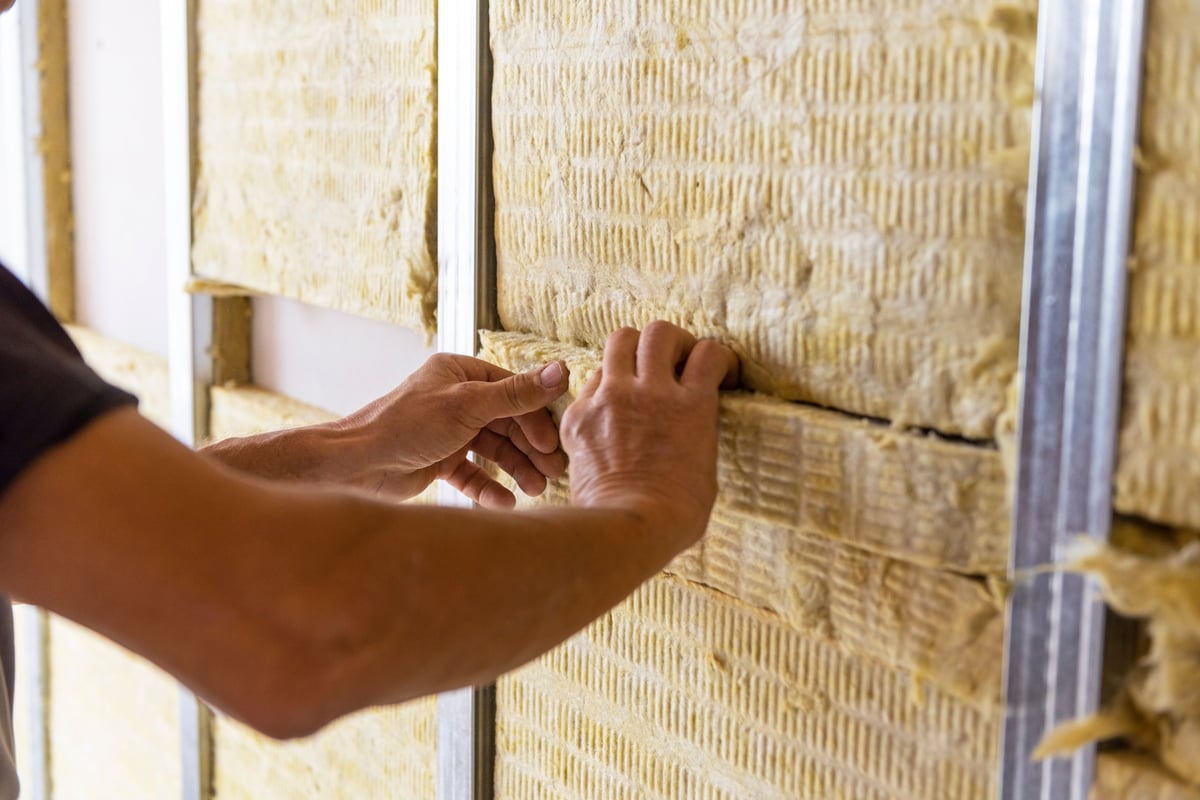
Construction and renovation interior with insulation

Fiberglass Insulation Installation for Central Illinois Homes and Buildings

Batt, roll, and blown-in fiberglass insulation for new construction walls, attics, floors, and garage ceilings. The most cost-effective insulation when installed correctly. The most underperforming insulation when it is not.

Fiberglass Insulation Works, But Only When It Is Installed Properly

Fiberglass is the most widely used insulation material in the United States. It is affordable, fire-resistant, non-combustible, and available in pre-cut widths that fit standard framing. It does not absorb moisture, does not support mold growth, and does not degrade chemically over time. When installed to manufacturer specifications in the right application, fiberglass delivers reliable thermal performance for decades.

The problem is that fiberglass is unforgiving of installation errors. A fiberglass batt rated R-13 delivers R-13 only when it fills the entire stud cavity with full contact on all six sides. Compress it behind a pipe and the compressed area drops to R-6. Leave a 2% void (a gap the size of a fist) and the whole bay loses up to 25% of its effective R-value.

The Installation Failure Point

These are not theoretical risks. They are what we find in the majority of homes we enter across central Illinois. Fiberglass batts installed by framers in a hurry, by homeowners from YouTube tutorials, or by insulation crews paid by the piece rather than by the hour. The material is fine. The installation is the failure point.

That is what professional fiberglass installation means. We cut every batt to fit around wires, pipes, and electrical boxes. We split batts around obstacles rather than compressing them. We fill the full depth of the cavity without compression and without voids. And we combine fiberglass with air sealing where it matters, because fiberglass does not stop air movement on its own.
Types of Fiberglass Insulation We Install

Fiberglass Batts (Faced and Unfaced)

Pre-cut panels sized to fit standard 16" and 24" stud spacing. Kraft-faced batts include an integrated vapor retarder. Unfaced batts are used where a separate vapor barrier is installed.

Available Thicknesses:

3.5" (R-13), 5.5" (R-19-21), 6.25" (R-19), 9.5" (R-30)

Best For:

New construction walls, floor assemblies, garage ceilings, basement headers, interior walls for sound control.

Fiberglass Rolls (Continuous Length)

Continuous rolls used for long, uninterrupted runs. Rolls reduce seams compared to individual batts, improving coverage uniformity.

Available Thicknesses:

Same as batts. Roll lengths from 32 to 88 feet.

Best For:

Attic floors in new construction, long floor joist bays, continuous wall runs without obstructions.

Blown-In Fiberglass (Loose-Fill)

Loose-fill fiberglass blown into attic floors and enclosed cavities. Non-combustible, settles less than cellulose (5% vs. 15-20%).

R-Value Per Inch:

R-2.2 to R-2.7. R-49 requires ~16-20 inches.

Best For:

Attic floor upgrades, topping off existing insulation, homes preferring non-cellulose products.

Where Fiberglass Insulation Belongs in a Central Illinois Home

Applications Where Fiberglass Performs Well

  • New construction wall cavities – When stud bays are open and accessible during framing, fiberglass batts can be installed with full cavity contact and no compression around obstacles.
  • Garage ceilings and shared walls – Provides thermal and fire separation at the lowest material cost.
  • Interior partition walls (sound control) – Unfaced fiberglass between bedrooms and bathrooms reduces sound transmission.
  • Floor assemblies over unconditioned spaces – Fiberglass batts between floor joists above unheated garages provide thermal resistance.
  • Second-layer attic insulation – Unfaced batts laid perpendicular across existing insulation add R-value without blowing equipment.

Applications Where Other Insulation Is Better

  • Existing wall retrofits – Cannot install batts in enclosed walls without removing drywall. Dense-pack blown-in cellulose is the right method. Learn more →
  • Crawl spaces – Fiberglass batts hung in crawl spaces absorb moisture, sag, and fail within years. Spray foam on walls is correct. Learn more →
  • Rim joists and band boards – Batts pull away from wood over time. Spray foam is the right material. Learn more →
  • Metal buildings and pole barns – Fiberglass between purlins leaves thermal bridges and does not control condensation. Learn more →
  • Air-sealing-critical assemblies – Attic bypasses and HVAC chases need spray foam or caulk, not fiberglass alone.

Six Fiberglass Installation Mistakes We Find in Central Illinois Homes

1

Compression Around Pipes and Wires

A batt pushed behind a pipe instead of being split around it loses 30-50% of its R-value. The fix: split the batt into two layers, one behind and one in front.

2

Voids at Electrical Boxes

Rectangular cutouts that are oversized leave exposed cavity. The fix: cut the batt to the exact contour of the box with no gap larger than 1/4 inch.

3

Wrong Thickness for the Cavity

A 6.25" R-19 batt in a 3.5" cavity delivers ~R-8. A 3.5" R-13 batt in a 5.5" cavity leaves a 2" air gap. Match batt thickness to cavity depth.

4

Kraft Facing on the Wrong Side

In Climate Zone 5, the vapor retarder should face the conditioned interior. Wrong orientation traps moisture. The fix: kraft facing always faces the warm-in-winter side.

5

Gaps Between Batts at Stud Bays

Adjacent batts that don't touch create a convective loop reducing effective R-value. The fix: batts fit snugly against each other with no visible gaps.

6

No Air Sealing at Penetrations

Batts stuffed around recessed lights and plumbing stacks without air sealing do nothing for air leakage. The fix: seal the penetration first, then install the batt.

How Much Does Fiberglass Insulation Cost in Central Illinois?

Fiberglass is the least expensive insulation material on a per-square-foot basis. Professional installation adds labor cost but ensures the insulation performs at its rated R-value. Poorly installed fiberglass that delivers 60% of its rated performance is not cheaper than professionally installed fiberglass that delivers 100%.

Project Typical Cost Range (Installed)
New construction walls, R-13 batts (2x4 framing) $0.80 – $1.50 per sq ft
New construction walls, R-21 batts (2x6 framing) $1.00 – $2.00 per sq ft
Attic floor, fiberglass batts, R-38 $1.25 – $2.00 per sq ft
Blown-in fiberglass, attic floor, R-49 $1.00 – $1.75 per sq ft
Garage ceiling, R-19 batts $1.00 – $1.75 per sq ft
Interior walls, unfaced R-13 (sound control) $0.75 – $1.25 per sq ft
Floor assembly over unconditioned space, R-19 $1.25 – $2.00 per sq ft

These are installed costs including material and labor. For new construction projects, we work from the builder's plans and provide a fixed-price proposal. For existing home upgrades, we assess the space and provide a written estimate.

How Fiberglass Compares to Other Insulation Options

Factor Fiberglass Batts Blown-In Cellulose Spray Foam (Closed-Cell)
R-Value Per Inch R-3.1 to R-3.8 R-3.2 to R-3.8 R-6.0 to R-7.0
Air Sealing None Moderate (dense-pack) Excellent
Vapor Retarder Kraft facing only None Yes (at 2"+)
Moisture Resistance Does not absorb Absorbs, can dry Blocks vapor
Cost (Installed) Lowest Moderate Highest
Best For New construction walls, budget projects Attic retrofits, wall retrofits Air sealing, moisture control, metal buildings

Summary: Fiberglass is the right choice when stud bays are open, air sealing is handled separately, and budget is a primary concern. When air sealing, moisture control, or retrofit access are factors, cellulose or spray foam will outperform fiberglass. We install all three and recommend the right material for each application.

Fiberglass Insulation Questions

Related Insulation Services

Blown-In Insulation

Blown-in fiberglass and cellulose for attic floors, enclosed wall cavities, and retrofit projects.

Spray Foam Insulation

For applications where air sealing and moisture control need to happen at the insulation layer.

Attic Insulation

Air sealing and insulation upgrades for central Illinois attics, including blown-in fiberglass options.

Get Professional Fiberglass Insulation Installation

Fiberglass insulation is only as good as the crew that installs it. We cut every batt to fit, split around every obstacle, and fill every cavity to full depth with no compression and no voids. 50 years of experience. Free estimates. New construction and existing home projects across central Illinois.