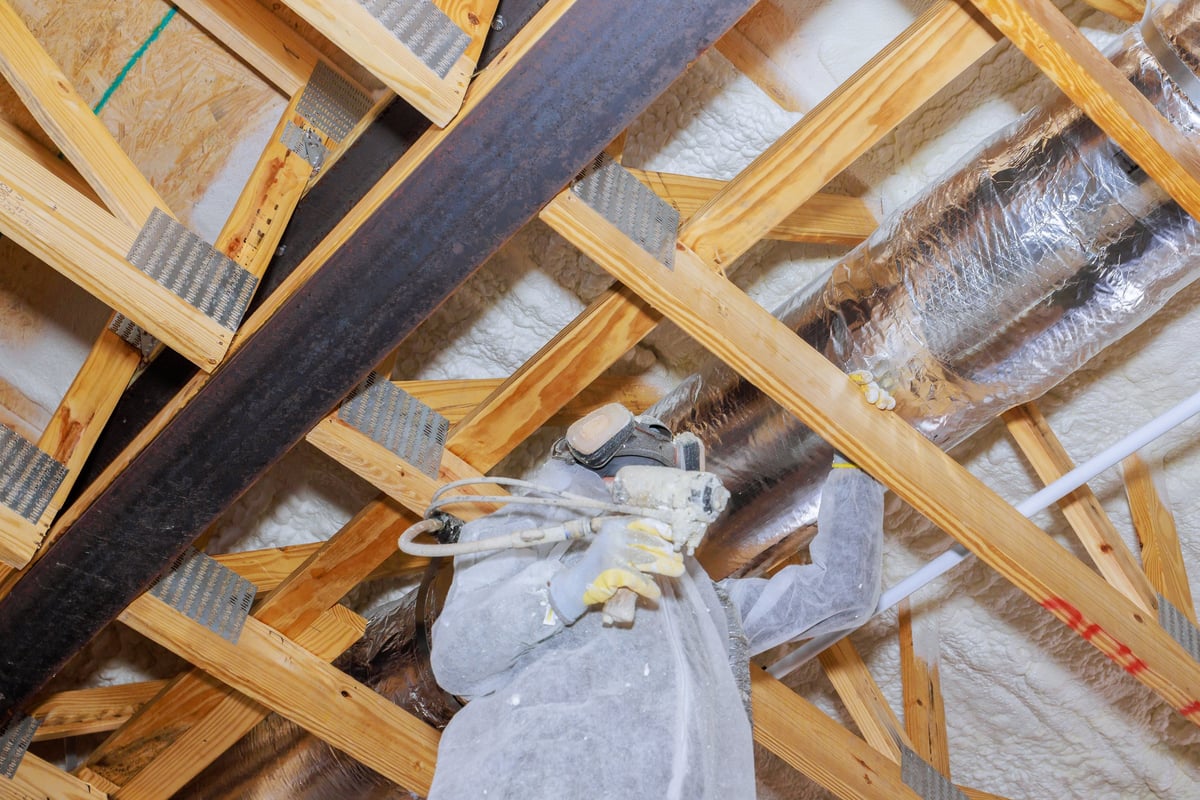
Construction worker is installing thermal barrier insulation in an attic with spray equipment to improve energy efficiency.

Spray Foam Insulation Contractor in Central Illinois

Open-cell and closed-cell spray foam for homes, commercial buildings, pole barns, and metal structures. Installed by a crew with 50 years of experience in the Mattoon, Champaign, and Decatur corridor.

What Spray Foam Insulation Does That Other Insulation Cannot

Spray foam insulation is a two-component polyurethane material that is sprayed as a liquid and expands into a rigid or semi-rigid foam within seconds. Unlike fiberglass batts or blown-in cellulose, spray foam bonds directly to the surface it contacts, filling every gap, crack, and irregular cavity without leaving voids. The result is a continuous air barrier and thermal barrier in a single application.

25-40%
of home energy lost through air leaks

In IECC Climate Zone 5, where winter temperatures drop into single digits and summer humidity exceeds 70%, air infiltration is the primary driver of energy loss. The U.S. Department of Energy estimates that air leaks account for 25% to 40% of energy used for heating and cooling. Spray foam stops those leaks at the source.

Insulation Service LLC has been installing spray foam insulation across central Illinois since the technology became available for residential and commercial applications. We install both open-cell and closed-cell spray foam, and we know where each one performs best.

50+ Years Experience
Open & Closed Cell
Central Illinois

Open-Cell vs. Closed-Cell Spray Foam: Which One Do You Need?

These are two fundamentally different products with different performance characteristics, different costs, and different best-use applications. Understanding the difference is the first step toward making the right investment.

Open-Cell Spray Foam

Open-cell spray foam contains cells that are not fully encapsulated, which makes the foam softer, more flexible, and lighter. It expands significantly during application (roughly 100x its liquid volume), which allows it to fill large cavities quickly and conform to irregular framing. Open-cell foam is an excellent air barrier but is not a vapor barrier, which means it allows moisture to pass through. That is an advantage in certain assemblies where drying potential to the interior is desirable.

R-Value Per Inch R-3.5 to R-4.0
Density 0.5 lb/ft³
Air Barrier Yes
Vapor Barrier No
Sound Dampening Excellent
Typical Cost Range $0.35 – $0.55 per board foot
Best Applications Interior walls, cathedral ceilings, attic rooflines, soundproofing

Closed-Cell Spray Foam

Closed-cell spray foam contains cells that are completely closed and packed tightly together, producing a rigid, dense material. It delivers roughly double the R-value per inch of open-cell foam and adds structural rigidity to the surfaces it covers. Closed-cell foam is both an air barrier and a Class II vapor retarder at 2 inches of thickness, making it the preferred choice for below-grade applications, crawl spaces, rim joists, and any assembly where moisture control is critical.

R-Value Per Inch R-6.0 to R-7.0
Density 2.0 lb/ft³
Air Barrier Yes
Vapor Barrier Yes (at 2+ inches)
Sound Dampening Good
Typical Cost Range $1.00 – $1.50 per board foot
Best Applications Crawl spaces, rim joists, basements, metal buildings, exterior walls, flood-prone areas

In most central Illinois homes, we use both types on the same project. Closed-cell goes where moisture management and maximum R-value per inch matter most (rim joists, crawl spaces, below-grade walls). Open-cell goes where large cavities need filling cost-effectively and sound dampening is a priority (attic rooflines, interior partition walls). We will tell you exactly where each type belongs in your building during your free estimate.

Where Spray Foam Insulation Goes in Your Home or Building

Attic Rooflines & Ceilings

Spraying the underside of the roof deck converts the attic into conditioned space, which eliminates ice dams, protects HVAC ductwork, and reduces summer heat gain by up to 40%. We typically use open-cell foam at 5.5 inches (R-20) on roof decks, supplemented by additional insulation where code requires higher R-values.

Rim Joists & Band Boards

The rim joist creates a continuous strip of air leakage around the entire perimeter of the house. Two inches of closed-cell spray foam on each rim joist cavity seals the gap permanently and delivers R-13 in a 2-inch layer, eliminating the drafts that make first-floor rooms uncomfortable.

Crawl Spaces

Closed-cell spray foam applied to crawl space walls (combined with a vapor barrier on the floor) creates a sealed, conditioned crawl space that eliminates moisture intrusion, prevents frozen pipes, and stops cold floors above.

Learn more about crawl space insulation →

Exterior Walls (New Construction)

In new construction, spray foam in wall cavities provides both insulation and air sealing in a single step. For 2x6 walls, 5.5 inches of open-cell foam delivers R-20, meeting the Illinois energy code prescriptive requirement for Climate Zone 5 without needing continuous exterior insulation.

Metal Buildings & Pole Barns

Spray foam applied directly to the interior face of metal panels eliminates thermal bridging through steel purlins and girts. It also stops the condensation cycle that causes rust, dripping, and mold on bare metal surfaces.

Basements & Below-Grade Walls

Below-grade concrete and block walls lose heat through direct contact with cold soil. Closed-cell spray foam applied to basement walls provides insulation, air sealing, and moisture protection in one application. At 2 inches of closed-cell, you get R-13 and a Class II vapor retarder.

Why Central Illinois Homeowners Choose Spray Foam

Lowest Air Leakage Rate

Spray foam delivers the tightest building envelope of any insulation material. Homes insulated with spray foam routinely test below 2.0 ACH50 on blower door tests, well under the Illinois code maximum of 4.0 ACH50.

Highest R-Value Per Inch

Closed-cell spray foam provides R-6 to R-7 per inch. No other commonly available insulation material matches this density of thermal resistance. That means better performance in thinner wall assemblies.

Built-In Moisture Control

Closed-cell spray foam at 2 inches acts as a Class II vapor retarder, reducing the need for separate vapor barriers. This simplifies wall assemblies and reduces the risk of moisture-trapped failures.

Structural Reinforcement

Closed-cell spray foam adds racking strength to the surfaces it bonds to. In metal buildings and pole barns, this additional rigidity helps stiffen wall and roof panels against wind loads.

Permanent Performance

Spray foam does not settle, sag, or compress over time. Unlike blown-in cellulose (which can lose 20% of its installed depth within the first few years), spray foam maintains its R-value and air-sealing performance for the life of the building.

Reduced HVAC Sizing

A tighter building envelope means your heating and cooling system works less. Many homeowners who upgrade to spray foam find they can downsize their HVAC replacement equipment, which offsets a portion of the insulation investment.

How Our Spray Foam Installation Works

1

Free On-Site Estimate

We visit your property, measure the areas to be sprayed, assess existing insulation and air-sealing conditions, and provide a written proposal with exact pricing. No cost, no obligation.

2

Pre-Installation Prep

Before spray day, we discuss what needs to happen in advance: clearing attic access, moving stored items away from crawl space walls, ensuring HVAC systems are off during application, and coordinating occupant re-entry timing (typically 24 hours after spraying).

3

Surface Preparation

Our crew masks and protects all surfaces that should not receive foam: windows, electrical panels, HVAC equipment, finished flooring. We verify that all wiring, plumbing, and framing inspections are complete (for new construction) before foam goes on.

4

Spray Application

We apply the foam in controlled lifts (passes), building up to the specified thickness. Our equipment monitors temperature, pressure, and chemical ratio in real time to ensure proper expansion and cure. Closed-cell foam is applied in 2-inch lifts. Open-cell foam can be applied in a single pass to fill the full cavity depth.

5

Trimming, Inspection & Walkthrough

After the foam cures, we trim any excess material flush with the framing, inspect the installation for voids or thin spots, and walk you through the completed work. We clean up all masking materials and debris before we leave.

50 Years of Spray Foam Insulation Experience in Central Illinois

Insulation Service LLC has been installing insulation in this region since 1974. We adopted spray foam technology early and have applied it to hundreds of structures across Coles, Douglas, Champaign, Macon, Shelby, and Effingham counties.

That depth of experience matters because spray foam is not a forgiving material. Improper chemical ratios produce foam that shrinks, cracks, or fails to adhere. Incorrect application temperatures cause poor cell structure. Over-application in a single lift generates excessive heat that can damage framing or create fire risk. Under-application leaves thin spots that defeat the purpose of the air barrier.

We have the equipment, the training, and the 500+ project track record to get it right. Every time.
Founded in 1974
500+ projects completed
Fully insured
100% satisfaction
24/7 support
Free estimates
50+
Years of Experience
500+
Projects Completed
100%
Satisfaction Rate

Spray Foam Insulation Questions from Central Illinois Homeowners

Related Insulation Services

Attic Insulation

Whether spray foam on the roofline or blown-in on the attic floor, we will determine which approach delivers the best performance for your home.

Attic insulation services →

Crawl Space Insulation

Closed-cell spray foam on crawl space walls combined with vapor barriers and vent sealing creates a dry, conditioned crawl space.

Crawl space insulation →

Pole Barn Insulation

Spray foam applied to the underside of metal roofing and wall panels stops condensation and creates a comfortable year-round workspace.

Pole barn insulation →

Metal Building Insulation

Eliminate thermal bridging and condensation in steel-framed commercial and agricultural buildings.

Metal building insulation →

Spray Foam Insulation Guides & Resources

Get a Spray Foam Insulation Estimate for Your Property

Whether you need spray foam in your attic, crawl space, rim joists, or an entire metal building, we will tell you exactly what type of foam you need, how much it will cost, and how long the job takes. 50 years of experience. 500+ projects. Free estimates with next-business-day scheduling.