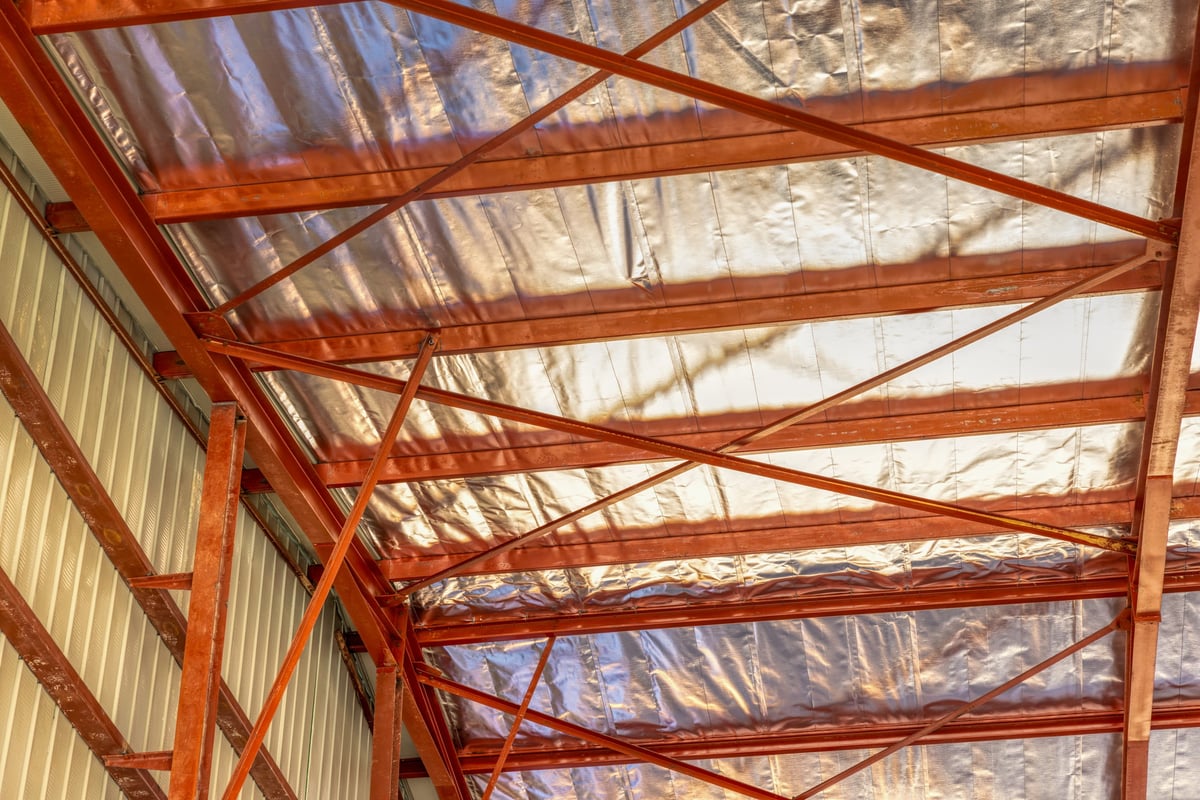
roof insulation indoors industrial warehouse with corrugated metal sheet and aluminum foil

Pole Barn Insulation for Central Illinois Farms, Workshops & Storage Buildings

Spray foam insulation that stops condensation, controls temperature, and protects what you store and build inside your pole barn. Serving Coles, Douglas, Champaign, Macon, and Effingham counties since 1974.

Why Uninsulated Pole Barns Fail in Central Illinois

A pole barn with bare metal siding and roofing is one of the most thermally volatile structures you can own. In central Illinois, where winter temperatures drop into the single digits and summer afternoons push past 95 degrees, an uninsulated pole barn swings 80 to 100 degrees in a single day.

-10°F
Winter Low
120°F
Summer Interior
100°
Daily Swing

The Primary Problem: Condensation

When warm, humid air contacts a cold metal surface, moisture condenses and drips. In winter, this happens every time temperature drops below the dew point. That dripping water lands on tractors, tools, feed, hay, and lumber—causing rust, mold, and corrosion over time.

In summer, the problem flips. Bare metal roofing absorbs solar radiation and re-radiates it into the building. Interior temperatures can exceed 120 degrees by midday, making the space unusable for work and dangerous for livestock or temperature-sensitive materials.

The Solution: Spray Foam

Insulation solves both problems simultaneously. It keeps the interior surface temperature of the metal above the dew point in winter and blocks radiant heat gain in summer.

Fiberglass: Gaps at every fastener
Spray Foam: Continuous, bonded layer

Why Spray Foam Is the Right Insulation for Pole Barns

We have insulated hundreds of pole barns, workshops, and agricultural buildings across central Illinois over the past 50 years. We have used fiberglass, reflective barriers, rigid foam board, and spray foam. For pole barns, closed-cell spray foam outperforms every other option. Here is why.

Eliminates Condensation

Closed-cell spray foam bonds directly to metal panels, eliminating the air gap where condensation forms. No dripping, no rust, no moisture damage.

No Thermal Bridging

Steel purlins conduct heat 400x more than wood. Spray foam covers purlins along with panels, creating a continuous thermal barrier with no bridges.

Air Sealing Included

Spray foam seals every gap at panel laps, fastener holes, ridge caps, and door frames as it expands and cures. No additional caulking needed.

Structural Reinforcement

Closed-cell foam adds measurable rigidity to metal panels, resisting wind deflection, reducing oil-canning, and strengthening the building envelope.

Pest & Rodent Resistance

Mice, birds, and insects nest in fiberglass. They cannot nest in cured spray foam. No food source, no nesting material, no entry points.

Permanent Performance

Spray foam does not sag, settle, absorb moisture, or degrade. Maintains R-value and air-sealing for the life of the building.

Types of Pole Barns and Agricultural Buildings We Insulate

Farm Workshops and Heated Shops

Pole barns converted into heated workshops need insulation that supports a conditioned environment. We spray the roof deck and walls with closed-cell foam to create a sealed, insulated envelope. Combined with a propane heater or forced-air furnace, the insulated shop maintains comfortable working temperatures through January and February without excessive fuel consumption.

Equipment and Machinery Storage

Tractors, combines, planters, and other farm equipment represent a significant capital investment. Storing them in an uninsulated pole barn exposes them to condensation, temperature cycling, and humidity that accelerates rust and deterioration. Insulating the roof alone (where most condensation forms) can protect stored equipment at a fraction of the cost of a full wall-and-roof insulation job.

Livestock and Animal Housing

Temperature regulation is critical for livestock health and productivity. Dairy operations, poultry houses, and horse barns all benefit from insulation that moderates temperature extremes and controls humidity. Spray foam's sealed surface is also easier to clean and does not harbor mold, bacteria, or parasites the way exposed fiberglass does.

Grain, Hay, and Feed Storage

Moisture is the enemy of stored agricultural products. Condensation dripping from an uninsulated roof onto hay bales creates mold. Humidity fluctuations in grain storage accelerate spoilage. Insulating the roof stops condensation, and the closed-cell foam's vapor retarder properties help stabilize interior humidity levels.

Open-Cell vs. Closed-Cell Spray Foam for Pole Barns

In our experience, 90% or more of pole barn insulation projects in central Illinois call for closed-cell foam. Here is how they compare.

Closed-Cell (Our Recommendation)

For most pole barn applications in central Illinois, we recommend closed-cell spray foam. Its higher density (2 lb/ft³), higher R-value (R-6 to R-7 per inch), and integrated vapor retarder properties make it the superior choice for metal buildings where condensation control is the primary objective.

R-Value Per Inch R-6 to R-7
Vapor Retarder Yes (at 2+ inches)
Condensation Control Excellent
Structural Benefit Yes
Typical Cost Higher

Open-Cell (Limited Use Cases)

Open-cell spray foam provides R-3.5 to R-4 per inch and is significantly less expensive per board foot. However, it is not a vapor retarder, which means it does not stop moisture migration as effectively. For pole barns where condensation control is the primary concern, open-cell is not the best choice.

R-Value Per Inch R-3.5 to R-4
Vapor Retarder No
Condensation Control Moderate
Structural Benefit Minimal
Typical Cost Lower

How We Insulate a Pole Barn

1

Free On-Site Assessment

We visit your pole barn, measure the roof and wall areas, assess the condition of existing metal panels and framing, identify any moisture issues or structural concerns, and discuss how you use the building. You receive a written estimate with specific pricing.

2

Building Preparation

Before spray day, the building interior needs to be cleared as much as possible. We mask and protect doors, windows, electrical panels, lighting fixtures, and any items that cannot be removed. If stored equipment or materials cannot be moved, we cover them with heavy plastic sheeting.

3

Surface Prep

Metal panels must be clean and dry for spray foam to bond properly. We remove any loose rust, dust, cobwebs, and debris from the surfaces being sprayed. If existing fiberglass insulation is present and has failed, we remove it before spraying.

4

Spray Application

Our crew applies closed-cell foam in controlled lifts (2-inch passes) to the specified thickness. For roof panels, we spray the underside of the metal, covering purlins and panel laps completely. For walls, we spray the interior face of wall panels and girts. The foam expands, bonds to the metal, and cures within minutes.

5

Inspection and Walkthrough

After the foam cures, we inspect for uniform thickness, verify coverage at critical areas (ridge, eave transitions, door frames, gable ends), and walk you through the completed work. We clean up masking materials and leave your building ready to use.

How Much Does Pole Barn Insulation Cost in Central Illinois?

Pole barn insulation costs depend on the size of the building, the areas being insulated (roof only vs. roof and walls), the thickness of foam applied, and the accessibility of the structure. Here are typical ranges for central Illinois projects:

Project Typical Cost Range
30x40 pole barn, roof only, 2" closed-cell $3,600 to $5,400
30x40 pole barn, roof and walls, 2" closed-cell $6,000 to $9,000
40x60 pole barn, roof only, 2" closed-cell $5,800 to $8,600
40x60 pole barn, roof and walls, 2" closed-cell $9,500 to $14,500
40x60 pole barn, roof and walls, 3" closed-cell (heated shop) $14,000 to $21,000
Old fiberglass removal (if needed) $1.00 to $2.00 per sq ft

These are installed costs including material, labor, and equipment. Roof-only insulation is the most common and cost-effective option for equipment storage buildings where full climate control is not needed. Adding wall insulation is recommended for heated workshops, livestock housing, and fully conditioned spaces.

Pole Barn Insulation Questions

Related Insulation Services

Metal Building Insulation

For steel-framed commercial and industrial buildings, we apply spray foam to eliminate thermal bridging and condensation across the entire structure.

Metal building insulation →

Spray Foam Insulation

Spray foam is the insulation method we use for pole barns. Learn about all residential and commercial spray foam applications.

Spray foam insulation →

Commercial Insulation

We insulate warehouses, shops, offices, and commercial buildings across central Illinois.

Commercial insulation →

Get a Pole Barn Insulation Estimate

Whether you need to stop condensation in a storage building, heat a workshop for winter, or convert a pole barn into a barndominium, we will assess your building and tell you exactly what it needs. 50 years of insulating agricultural and commercial buildings across central Illinois. Free estimates. Next-business-day scheduling.