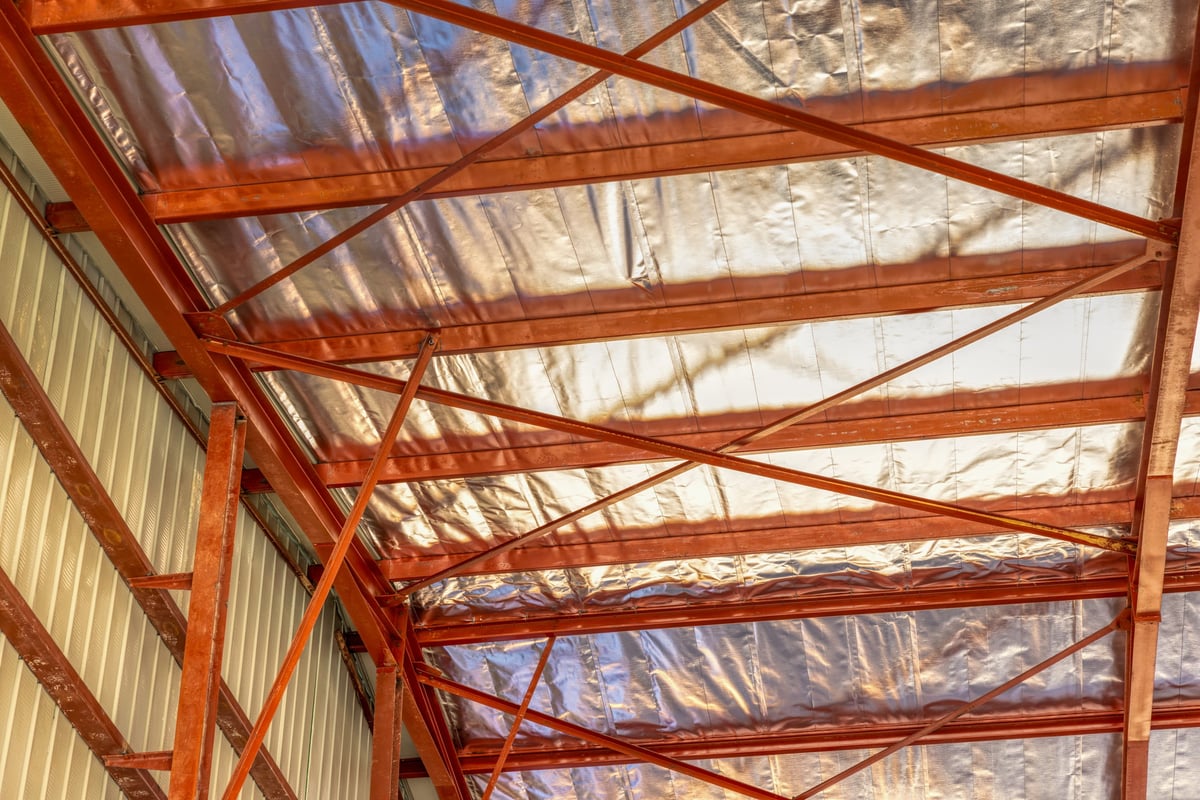
Closed-cell spray foam insulation that eliminates thermal bridging, stops condensation, and transforms steel-framed buildings into controlled, efficient environments. Serving the I-57 corridor since 1974.
Metal buildings are engineered for strength, speed of construction, and cost. They are not engineered for thermal performance. The steel framing, wall panels, and roof panels that make metal buildings economical are also the reason they are so difficult to keep comfortable.
Steel conducts heat approximately 400 times faster than wood. Every steel purlin, girt, column, and fastener acts as a thermal bridge, bypassing insulation placed between framing members. A metal building with R-19 fiberglass batts may test at effective whole-wall R-value of R-10 or less.
In central Illinois winters, when interior air at 65°F contacts a steel purlin at 20°F, moisture condenses on the steel surface. Over a heating season, that condensation causes rust on framing, corrosion on fasteners, mold on stored materials, and water stains on finished surfaces.
The only insulation method that solves both problems simultaneously is spray foam applied directly to the interior face of the metal panels, covering the purlins, girts, and panel laps with a continuous layer of closed-cell foam. No gaps. No thermal bridges. No condensation surface.
We have insulated metal buildings with fiberglass batts, vinyl-backed blanket insulation, rigid foam board, and spray foam. After 50 years and hundreds of metal building projects, our recommendation is clear: closed-cell spray foam is the correct insulation for steel-framed structures.
Spray foam covers panels, girts, fasteners, and lap joints in a single unbroken layer. No gap at framing, no air space behind, no exposed steel for moisture.
2 inches of closed-cell foam delivers R-13 across the full assembly—not R-13 between purlins and R-1 at the purlin.
Closed-cell spray foam at 2 inches acts as a Class II vapor retarder. No separate poly sheeting needed at the insulation layer.
Seals panel laps, ridge caps, endwall transitions, door frames, and every screw penetration. Substantially tighter building envelope.
By keeping interior metal surfaces above dew point, spray foam prevents the condensation cycle that causes rust on purlins, girts, and fasteners.
Bonds permanently to metal, doesn't sag, and provides no nesting material for pests. Lasts the life of the building.
Steel-framed warehouses used for inventory, manufacturing, and distribution need stable interior temperatures and humidity levels. We insulate roof and wall panels to reduce HVAC load and prevent condensation damage to products and racking systems.
A barndominium must meet the same energy code requirements as any home in Illinois. We apply 3 to 4 inches of closed-cell spray foam (R-20 to R-28) to roof and wall panels to meet the 2021 IECC requirements for Climate Zone 5.
Heated metal buildings for automotive repair, welding, and fabrication need insulation that withstands contact and shop conditions. Closed-cell spray foam's rigid surface holds up to incidental contact and can be painted or coated for a finished appearance.
Metal buildings used for grain drying, seed storage, cold storage, and food processing require tight temperature and humidity control. Spray foam provides the thermal and vapor performance these applications demand, with a closed-cell surface that resists mold and bacteria.
Metal building manufacturers often offer vinyl-backed fiberglass blanket insulation as a factory option. It is the least expensive method, and it is the one we most frequently replace.
| Factor | Fiberglass Blanket | Closed-Cell Spray Foam |
|---|---|---|
| Effective R-Value | 40-60% of rated (thermal bridging) | Near 100% of rated (purlins covered) |
| Thermal Bridging | Purlins fully exposed | Purlins covered by foam |
| Condensation Control | None | Excellent |
| Air Sealing | None | Complete |
| Vapor Retarder | Vinyl facing tears over time | Integrated at 2+ inches |
| Pest Resistance | Poor (nesting material) | Excellent |
| Lifespan | 10-15 years before degradation | Life of the building |
If your metal building has failed fiberglass blanket insulation that has sagged, torn, or accumulated moisture and pest damage, spray foam is the retrofit solution. We remove the failed fiberglass, clean the metal surfaces, and spray closed-cell foam directly to the panels.
Metal building insulation costs depend on the size, areas being insulated, foam thickness, and whether existing insulation needs removal.
| Project | Typical Cost Range |
|---|---|
| 30x50 metal building, roof and walls, 2" closed-cell | $7,200 to $10,800 |
| 40x60 metal building, roof and walls, 2" closed-cell | $11,500 to $17,200 |
| 40x80 metal building, roof and walls, 2" closed-cell | $15,400 to $23,000 |
| Barndominium (40x60), roof and walls, 3" closed-cell | $17,000 to $26,000 |
| 60x100 warehouse, roof only, 2" closed-cell | $14,400 to $21,600 |
| Old fiberglass blanket removal | $0.75 to $1.50 per sq ft |
These are installed costs. For unheated storage where condensation control is needed, 2" of closed-cell foam (R-13) is typically sufficient. For conditioned spaces, 3" (R-20) or more may be appropriate. We provide exact pricing in your free estimate.
We visit your building, measure all roof and wall surfaces, assess existing insulation, check for moisture issues, and document your intended use. You receive a written estimate with specific pricing.
We mask and cover windows, doors, electrical panels, overhead doors, lighting, and HVAC equipment. For occupied commercial buildings, we coordinate timing to minimize disruption.
If the building has failed fiberglass blanket insulation, we remove it completely, dispose of the material, and clean the metal panel surfaces for proper spray foam adhesion.
We apply closed-cell foam in 2-inch lifts to the specified thickness. Roof panels, wall panels, purlins, girts, and all transitions receive continuous coverage. Our equipment monitors ratio and temperature for consistent cell structure.
After curing, we inspect for uniform thickness, verify coverage at all transitions and penetrations, and walk you through the completed installation. We remove all masking materials.
Pole barns use wood-post framing with metal siding. The insulation approach is similar, with spray foam applied to the metal panels.
Pole barn insulation →We insulate offices, retail spaces, warehouses, and multi-unit commercial buildings across central Illinois.
Commercial insulation →Closed-cell spray foam is the insulation method we use for metal buildings. Learn about all spray foam applications.
Spray foam insulation →Whether you are building new, retrofitting an existing structure, or converting a metal building into a barndominium, we will assess your building and provide a specific insulation plan. 50 years of insulating steel-framed buildings across central Illinois. Free estimates. Next-business-day scheduling.